
Casino Cruises: How Gambling Works on the Open Sea in 2026
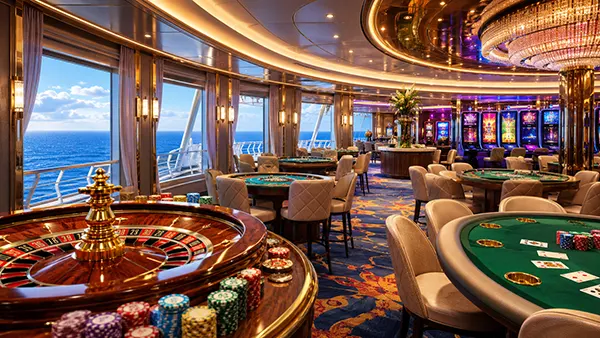
Casino cruises combine an ordinary sea voyage with gambling facilities that operate according to the ship’s route, location and onboard rules. A cruise casino is not a law-free room that automatically starts taking bets as soon as the vessel leaves the harbour. Its opening hours can depend on coastal legislation, the waters through which the ship is travelling, the country where the vessel is registered and the policies of the cruise operator. In 2026, large cruise ships may carry substantial gaming areas with slot machines, blackjack, roulette, poker variants, craps and organised tournaments, while other vessels have no casino at all. For passengers, the important questions are therefore practical ones: when gambling is permitted, what minimum age applies, how bets and winnings are handled and which rules remain relevant after the ship has sailed away from land.
Why Cruise Casinos Operate Only at Certain Points of a Voyage
The common idea that gambling becomes legal immediately after a ship crosses a single line in the sea is too simple. Under the United Nations Convention on the Law of the Sea, a coastal state may establish a territorial sea extending up to 12 nautical miles from its recognised baseline. Within that area, the coastal state has sovereignty over the waters, although international maritime rules still affect how ships may pass through them. This means a cruise operator has to take the laws of the country beside which the vessel is sailing into account. If local rules prohibit casino gambling or require an authorisation that the operator does not hold, the gaming area will normally remain closed.
The expression “international waters” is commonly used by cruise companies when explaining casino schedules to passengers, but its legal meaning is more complicated than the wording suggests. Waters beyond a country’s territorial sea can still form part of its exclusive economic zone, while the high seas are treated separately under international maritime law. On the high seas, a vessel is generally subject to the jurisdiction of the country whose flag it flies. Consequently, the legal position of an onboard casino can involve several layers at once: the coastal country, the ship’s flag state, the itinerary and the cruise company’s own operating rules. There is no worldwide rule saying that every casino must open at precisely 12 nautical miles from shore.
The United States provides a useful example of how specific national legislation can affect cruise gambling. Federal law contains exceptions allowing gambling devices to be used on certain vessels when they are outside the boundaries of a US state or possession, but it also contains additional provisions for particular voyages. Alaska has its own cruise-related conditions: qualifying ships may operate gambling devices, although Alaska can restrict their use while a vessel is docked, anchored or operating within three nautical miles of a scheduled port. Hawaii is treated differently under the federal provisions. These distinctions show why the actual itinerary matters more than a simple claim that a ship is “offshore”.
Legal Age Rules Depend on the Ship and Itinerary
The minimum gambling age at sea is not identical across every cruise or destination. Royal Caribbean states that guests generally need to be at least 18 to gamble in its casinos, while passengers on Alaska sailings must be at least 21. Carnival also sets 18 as the minimum age for playing tables and slot machines and does not permit guests under 18 in its casinos. Norwegian Cruise Line similarly requires casino players to be at least 18. These examples show why passengers should check the conditions for their exact sailing rather than relying on the casino age used in their home country.
The gambling age can also be different from the minimum age for drinking alcohol on the same ship. On Royal Caribbean sailings originating in North America or the Caribbean, for example, the minimum drinking age is 21 even though casino gambling is generally available from 18 outside Alaska. Carnival likewise requires passengers to be 21 to be served alcohol while allowing casino gambling from 18. A passenger who is legally old enough to play roulette may therefore still be too young to order an alcoholic drink at the casino bar. Cruise companies can request government-issued photographic identification when confirming a player’s age.
Passengers should also remember that company rules can be stricter than the minimum permitted by law. A cruise operator may change an age requirement when local legislation or a particular itinerary requires it. The passenger ticket contract and current onboard policies are therefore important documents, especially on voyages that enter several countries during the same week. The legal situation is determined by more than the passenger’s nationality or the port where the holiday began. The ship’s registration, its present location and the countries included in the route can all affect when and how gambling takes place.
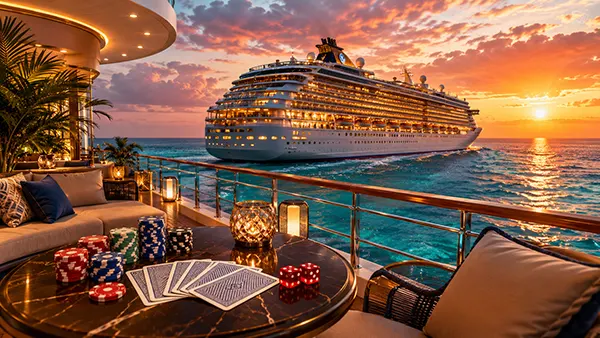
What Passengers Find in a Cruise Ship Casino
Most large cruise casinos resemble compact land-based gaming rooms rather than a separate gambling vessel. Slot machines usually occupy a substantial part of the floor because they require less space than staffed tables and can remain available whenever the casino is open. Table selections commonly include blackjack and roulette, with craps, baccarat, Three Card Poker and other variants appearing on selected ships. Video poker is also common. Carnival, for example, lists blackjack, roulette, craps, Texas Hold’em, Three Card Poker, Let It Ride and slot machines among its onboard games. The exact selection and number of tables can change from one vessel to another.
Casino activity can extend beyond ordinary cash play. Cruise companies operate loyalty schemes, slot competitions, blackjack events and poker tournaments, and some voyages are scheduled specifically around casino events. Norwegian Cruise Line’s published 2026 programme includes several slot tournaments as well as poker events on selected sailings. This does not mean that an ordinary cruise becomes a gambling-only holiday. Casinos remain one part of the onboard entertainment schedule, alongside restaurants, theatres, pools, excursions and other facilities, and their operating times are restricted when the vessel enters ports or waters where gambling cannot continue.
Game rules should be checked at the table rather than assumed from previous experience elsewhere. Blackjack payouts, side bets, roulette layouts, poker charges, table limits and available slot denominations can differ by vessel. Even two ships owned by the same company may not offer an identical gaming floor. Cruise operators themselves note that game availability and minimum bets can vary. For that reason, a passenger who cares about a particular game should check information for the specific ship before booking and then confirm the current limits onboard. A familiar game name does not necessarily mean that every rule or betting condition is identical to those used at a land-based casino.
Opening Hours, Cash and Onboard Casino Accounts
Opening times are closely linked to the voyage. Celebrity Cruises states that its casinos generally open when ships enter international waters and close while the vessel is in port. Norwegian Cruise Line similarly states that its casino is closed when a ship is in territorial waters that prevent gambling without specific authorisation. Carnival advises passengers that casino hours vary according to itinerary and provides the current timetable onboard. This makes sea days particularly different from port days: on a full day between destinations, a casino may operate for a much longer period, while during a long port visit it may remain closed until the ship is back at sea.
Payment arrangements also vary. Cash is still accepted by several major cruise casinos, but passengers may also be able to charge gaming funds to their onboard account through the card used for cabin access and shipboard purchases. Norwegian offers cashless wagering through the guest’s onboard account and states that convenience fees and daily or cruise limits can apply. Its casino gaming is conducted in US dollars, with certain foreign currencies exchangeable at the cashier. Carnival accepts cash in its casinos on cruises departing from North America and Europe, while Australian cruises use Australian dollars for cash transactions. Currency conversion can therefore add another cost for passengers whose normal account is held in a different currency.
Casino chips, gaming tickets and account balances also need attention before disembarkation. Norwegian states that gaming vouchers and table-game chips are redeemable only during the current cruise, while Royal Caribbean advises guests to exchange casino chips, plaques and gaming tickets before the voyage ends. Leaving this until after disembarkation can create problems because cruise casino instruments are not necessarily redeemable through an ordinary bank or another casino. Passengers making larger transactions should retain receipts and account statements. Keeping a clear record is also useful if winnings later need to be reported for tax purposes or if a payment has to be checked with the cruise operator.
What to Check Before Booking a Casino Cruise
The first point to check is the itinerary rather than simply the presence of a casino on the deck plan. A voyage with several long port calls can provide considerably fewer gambling hours than a transatlantic crossing or another route containing multiple sea days. Each time the vessel reaches waters where the casino cannot legally operate, play may stop. An itinerary can also change because of weather, port restrictions, safety considerations or other operational decisions, and casino hours may change with it. A passenger should therefore treat published schedules as guidance for the planned voyage rather than a guarantee that a gaming room will remain open for a fixed number of hours.
It is equally important to confirm that the chosen ship actually has a casino. Royal Caribbean currently states that its ships carry Casino Royale facilities, but this is not a rule for the entire cruise industry. Norwegian Cruise Line specifically states that Pride of America has no casino. Smaller vessels and ships designed around other forms of travel can also provide a different entertainment mix. Checking the exact vessel prevents the common mistake of assuming that every large passenger ship automatically includes gambling simply because other ships operated by the same company do.
Passengers who intend to gamble should check several details before departure: the minimum casino age, available games, expected currency, possible account or cash-advance fees, smoking rules, redemption procedures and operating hours. Table minimums matter as well because a gaming budget suitable for one ship may be impractical on another with higher minimum stakes. Anyone joining a tournament should check the entry fee and prize conditions separately from ordinary casino play. These details are usually more useful than general descriptions of a ship’s casino because they determine how much gambling will actually cost and whether the available games match the passenger’s expectations.
Budgeting, Tax Records and Responsible Gambling at Sea
An onboard account makes spending convenient, but that convenience can make the total amount wagered less obvious than paying repeatedly with physical cash. A sensible approach is to decide on a separate gambling budget before the ship leaves port and keep it independent from money reserved for accommodation charges, excursions, meals, transport and emergencies. ATM charges, currency conversion and casino-account fees can increase the real cost of a session without increasing the amount placed in bets. Once the planned gambling budget has been used, increasing it to recover previous losses changes a fixed entertainment expense into an open-ended financial risk.
Being at sea does not automatically make gambling winnings tax-free. Tax treatment depends on the rules relevant to the individual player. For UK customers, the Gambling Commission confirmed in 2026 that customer gambling winnings are tax-free in the UK, with gambling duties instead imposed on operators. The position is different for US taxpayers: the Internal Revenue Service states that gambling winnings are generally taxable and must be reported, including winnings that do not result in a Form W-2G. Reporting and withholding requirements depend on factors such as the game and amount won. Passengers with significant wins should therefore keep casino statements and check the rules that apply to their own tax position rather than assuming that offshore play removes reporting obligations.
A casino cruise works best when gambling is treated as one optional expense within a larger holiday budget. Before sailing, a passenger can confirm the rules for the exact ship, check when its casino normally operates, understand the currency and payment method, set a maximum spend and know when chips or tickets must be redeemed. During the voyage, tracking wagers and account charges gives a more accurate picture of expenditure than relying on memory after several sea days. Cruise casinos operate under a combination of maritime rules, national laws and company policies, so careful preparation is more reliable than assumptions about what becomes legal once land disappears from view.